CiteDash AI vs ChatGPT for writing a thesis
An honest comparison of CiteDash AI and ChatGPT for thesis writing: where each helps, where free-text citations break, and what survives a viva.
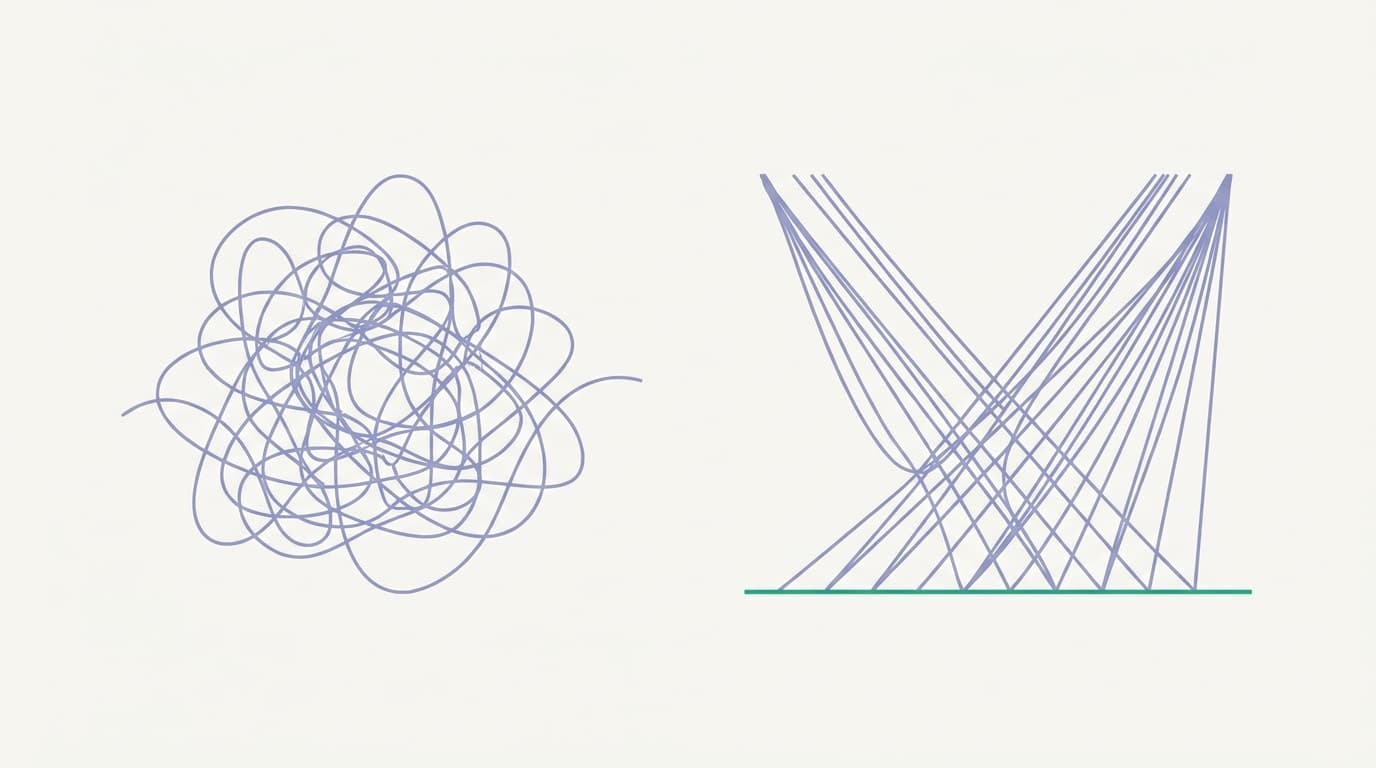
If you are weighing ChatGPT against a purpose-built research workspace for your thesis, you deserve a straight comparison rather than a sales pitch. ChatGPT is a genuinely useful general assistant, and pretending otherwise would insult your intelligence. But a thesis is not a general writing task. It is a document in which every claim can be challenged, every reference will be checked, and a single invented citation can cost you the credibility of the entire submission. This comparison walks through the real differences, including the places where ChatGPT is the right choice, so you can decide where each tool belongs in your workflow.
The short version: the difference is not intelligence, it is grounding. One tool produces plausible text about sources; the other produces text bound to sources it holds and has checked. Everything below is that one difference, worked out in detail across the life of a thesis.
What ChatGPT does well for thesis work
Used for the right jobs, a general chatbot earns its place in a PhD. It positions itself as an all-purpose assistant, and for thinking work with no citation attached it is often excellent. It is also fast and frictionless, which matters at 11pm when you need a concept unstuck and nobody is answering email. None of the criticism below argues that you should never open a chat window. The argument is about where the line sits, and thesis writing crosses it earlier than most students expect.
There is also a version of this comparison that misleads: judging a chatbot by asking it to write the whole thesis and watching it fail. Nobody serious proposes that. The realistic scenario is a student using it for a paragraph here and a summary there, and the realistic risk is that the boundary between safe uses and citation-bearing uses erodes gradually, one deadline at a time. That is why the rest of this piece is specific about where the boundary is.
Jobs where a general chatbot is a reasonable first stop:
- Explaining an unfamiliar statistical or theoretical concept in plain language before you read the formal treatment.
- Brainstorming angles, counterarguments, and chapter structures before you commit to one.
- Rephrasing a clumsy paragraph of your own writing for clarity, where you remain the author of the content.
- Drafting thesis-adjacent boilerplate: an email to a supervisor, a first pass at an abstract you will rewrite.
- Rubber-duck reasoning: talking through a design decision to find the holes in it yourself.
Where ChatGPT breaks for a thesis: citations as free text
The core problem is structural, not carelessness. In a chat window, a citation is text the model writes: a plausible author, year, title, and DOI generated by the same mechanism as the sentence around it. Scholarly references follow a highly regular pattern, which makes them easy to produce convincingly with no connection to any real paper. That is why fabricated references keep surfacing in submitted work, and why asking the model to only cite real sources changes the wording of the failure, not the mechanism behind it. Versions with web browsing can retrieve genuine pages, but the reference that lands in the reply is still free text the model composed, so the failure mode stays open. The mechanism is unpacked fully in why AI makes up citations.
CiteDash removes the possibility instead of discouraging it. Here, a citation is not text a model writes; it is a database object that must resolve to a real paper record, and a generated citation that does not resolve is rejected before you ever see it. There are no free-text references anywhere in the product, so a fabricated reference has nowhere to exist. That is a categorically different promise from a tool trying hard not to fabricate: it is a tool that structurally cannot.
It is worth sitting with why prompting cannot close this gap. An instruction changes what the model tries to say; it does not change how references come into being. As long as a reference is generated token by token, the system that produced your bibliography and the system that produces fiction are the same system. Structure, not effort, is the only fix, which is why the fix had to be built into the product's data model rather than into a cleverer prompt.
Real citations are not enough: claim-source verification
The subtler failure is a genuine paper cited for a claim it never makes. A chatbot cannot reliably catch this, because it is not reading the paper as it writes; it is recalling a compressed impression of it, or paraphrasing a search snippet. The output reads perfectly and fails the moment an examiner opens the source, which examiners increasingly do, precisely because this failure has become common.
CiteDash's Fact Checker verifies every cited claim against its source before the claim reaches you, grounded in the full-text PDFs the platform holds, never in a model's memory of a paper. Each claim comes back supported, partial, unsupported, or unverified, and an honest unverified is exactly what you get when the full text is not held, rather than a confident guess. The four verdicts, and how to fix each one, are covered in how verified citations work.
Notice that these are two separate questions: does the reference exist, and does it say what you claim it says. A general chatbot fails the first question sometimes and cannot answer the second at all. A thesis has to pass both, for every cited sentence, and manual checking of both at thesis scale is weeks of work.
A worked example: the same paragraph in both tools
Suppose you need a paragraph on whether mindfulness interventions reduce anxiety in undergraduates. In a chat window, you ask and receive fluent prose with three references. Now the real work begins: you look each one up. One resolves and is relevant. One resolves but studied a clinical population, not undergraduates, so the claim attached to it overreaches. One does not appear in any database. Twenty minutes have gone to verification, the paragraph still is not usable, and the argument was shaped around references you now cannot keep, so you are not editing, you are starting over.
In CiteDash, the order of operations is reversed. You search the live literature, save the papers that actually studied your population, and let the Thesis Editor draft from their full text. Each sentence arrives already carrying a citation that resolves and a verdict from the Fact Checker. Where the evidence is thin, the draft is flagged as thin rather than padded to sound complete. The work you do afterwards is scholarly work, judging and sharpening an argument whose evidence you can see, not clerical work establishing whether the evidence exists.
The time difference is real, but it is not the main point. The main point is what state your chapter is in when you stop: in one case, prose of unknown reliability; in the other, prose where every claim carries a verdict you can act on.
One conversation vs the whole thesis lifecycle
A thesis is a dozen jobs in sequence: finding a question, searching the literature, reading, synthesising, analysing data, drafting, revising, citing, checking, and compiling. ChatGPT gives you a conversation that can touch any of them shallowly, with nothing persisting between them except what you paste. CiteDash gives you connected tools that carry one project through all of them, with the same library and the same verification ledger underneath every stage.
In concrete terms: the Literature Finder searches an internal corpus plus live OpenAlex, PubMed, Semantic Scholar, and arXiv, reaching 250 million+ works in one search. The Library answers questions over your PDFs with sentence-level provenance and blocks retracted papers from citation. The Synthesis Lab builds evidence matrices across papers and supports PRISMA-friendly systematic reviews. Data Analysis runs thirteen named statistical tests on your uploaded CSV as real computation, with charts. The Proof Reader audits revisions so edits do not silently break the claims behind your citations. And the Thesis Assembler compiles to DOCX, PDF, or LaTeX with a citeproc bibliography in any of twelve citation styles, from APA and Harvard to Vancouver and IEEE.
The connective tissue matters as much as the list. Because reading happens in the same workspace as writing, a passage you extract while reading is available as grounded evidence when you draft, with sentence-level provenance pointing back to the exact spot in the source. Because citing happens in the same workspace, the Reference Manager formats the bibliography from citation records that verification has already touched, rather than from a list you maintained by hand. Nothing needs exporting, and nothing loses its provenance in transit between apps.
Just as important for a thesis: every step is logged, so the AI-use disclosure your institution may require is generated from an actual record rather than reconstructed from memory at submission time. A chat window keeps no such trail, which turns your disclosure statement into guesswork about your own process. There is a full guide to writing one, with worked examples, in our disclosure guide.
CiteDash vs ChatGPT: side by side
The comparison in one list:
- Citations guaranteed to resolve to real papers: ChatGPT no, references are free text; CiteDash yes, citations are database objects rejected if they do not resolve.
- Claims verified against the source's full text before you see them: ChatGPT no; CiteDash yes, with four honest verdicts.
- Scholarly search: ChatGPT general web browsing at best; CiteDash an internal corpus plus OpenAlex, PubMed, Semantic Scholar, and arXiv in every search.
- Drafting grounded strictly in your own library's full text: ChatGPT no; CiteDash yes.
- Retracted papers flagged and blocked from citation: ChatGPT no; CiteDash yes, with retraction badges in the Library.
- Statistics computed from your data: ChatGPT narrates numbers; CiteDash runs thirteen named tests on your uploaded CSV.
- Bibliography in twelve citation styles, compiled to DOCX, PDF, or LaTeX: ChatGPT no; CiteDash yes.
- Audit trail and a generated AI-use disclosure: ChatGPT no; CiteDash yes.
Common objections, answered
'I check every reference myself anyway.' Good, and you will still miss the second failure mode: a real paper cited for a claim it does not make, which requires reading the source, not just locating it. Full-text verification does that reading systematically, for every claim, every time, and shows you the verdicts instead of asking for your trust. Manual checking also does not scale to a revision cycle: every edit that changes a claim's meaning re-opens the question, and nobody re-reads forty sources per editing pass.
'Browsing has fixed the hallucination problem.' It has reduced one version of it. A browsing model can fetch a real page, but the citation it writes into your text is still free text, and nothing checks the finished claim against the source before you paste it into a chapter. Reduced is not the standard a thesis is marked against.
'My supervisor is fine with ChatGPT.' Then use it where it is strong, and keep records. Most policies that permit AI use require disclosure, and a disclosure written from memory months later is either uselessly vague or accidentally wrong. Whatever tools you use, log what they did as you go, because the burden of that statement falls on you, not on the tool.
'The newest models hallucinate less.' Probably true, and irrelevant at the margin that matters. A thesis has hundreds of cited sentences, and the failure that ends badly is the one you did not catch. A lower error rate changes how often you get burned, not whether you can prove you were not. Verification you can inspect beats an error rate you have to take on faith.
'What about cost?' This post will not quote figures, because posts outlive price lists. CiteDash plans are on the pricing page, and the fair comparison is against the hours you currently spend verifying references, reformatting bibliographies, and re-finding quotes you failed to write down.
What your examiner will actually ask
Examiners rarely ask which software you used. They ask whether you can defend what is on the page: where did this claim come from, why do you trust this source, what did the AI contribute, do your references check out. Those are records questions, and a chat history is the worst possible answer to them, because a chat history is organised around conversations, not around claims and sources.
Concretely, the questions sound like this. Why did you cite this paper for this claim, when its sample was clinical rather than general? What did you use AI for in chapter two, and how do you know its output was accurate? This reference is to a study that was later retracted; when did you last check your sources? With a chat-based workflow, each of those is an archaeology project through months of transcripts. With a ledgered workflow, each one is a lookup.
A grounded workspace answers them by construction. Every citation resolves to a real paper. Every claim carries a verdict against held full text, with the supporting passage attached. Retracted sources were blocked before they could be cited. The originality pre-check ran before submission rather than after, and the disclosure statement was generated from the project's real activity. That is what defensible looks like from the examiner's side of the table, and it is the position you want to be arguing from in a viva.
How to run this comparison yourself
Do not take this article's word for it. Run the comparison on your own research topic in an afternoon:
- Ask ChatGPT for a cited paragraph on your research question, then look up every reference in a scholarly database and note how many resolve.
- For one reference that does resolve, read the source and check whether it actually makes the claim attributed to it.
- Run the same question in CiteDash, open any generated citation, and follow it to the exact passage that supports it.
- Ask both tools for evidence the literature cannot supply, and watch which one tells you so instead of improvising.
The honest verdict
Keep ChatGPT for what it is good at: explaining, brainstorming, and language help on text where nothing needs a source. Reach for CiteDash the moment a sentence needs a citation you may have to defend, which in a thesis is most of the sentences that matter. The two are not really competitors. One is a conversation; the other is a system of record for your evidence. A thesis needs the second, and no amount of prompting can retrofit it onto a chat window after the fact.
If you use both, draw the line deliberately: ideas and language on one side, claims and citations on the other, and never let text cross from the first side to the second without passing through verification.